Choosing a niche for an AI influencer
How to pick a niche for a virtual influencer: subcultures, travel content, look, and growth hypotheses.
How we tested
Niches are working hypotheses for content, not guaranteed reach. Face and clip examples used Nano Banana Pro and Seedance/Kling in NEIRON, one look across a series.
Table: niche → models
| Niche | Content | Face | Video | Risk |
|---|---|---|---|---|
| Subcultures | Look, motion, aesthetic | Nano Banana Pro | Seedance / Kling Motion | Copying a scene you do not know |
| Travel | Place + character | Pro + location ref | Kling / Veo | Stock views with no face |
| Fashion | Lookbook, poses | Pro, a still series | Seedance | Face drift clip to clip |
See also
Why niche is the key factor
Looking at popular AI-girl accounts, it is easy to conclude that success just takes an attractive model and a steady stream of content that leans on her looks. That hypothesis is partly true.
Striking looks and a good format can genuinely get a clip a huge number of views, reactions and comments. They are effective at grabbing a viewer’s attention on first contact.
But looks alone are not enough to make an audience follow a character over the long run. For that, a blogger needs a personality, a world, interests, habits and a story of their own. Niche is exactly what builds that context and helps viewers sink deeper into a virtual influencer’s universe.
The chosen direction shapes almost everything:
- the character’s visual identity: outfits, makeup, hairstyle and facial features;
- the format of clips and posts;
- the search for suitable references among real and virtual bloggers;
- how the account grows going forward;
- the concept behind the Telegram channel;
- the structure of a closed or paid community.
The result is a full environment built around the model that reflects her interests, lifestyle and implied inner world.
How to pick the right niche
The first thing to keep in mind: directly copying an already-popular AI model rarely gives you a strong competitive edge. It can work, but pulling off rapid audience growth in a short time becomes much harder.
Your virtual character is competing with the entire content market, not just other AI girls. So when building a strategy, look at the general laws of social media, study ordinary creators, trends, subcultures and entertainment formats.
The alt-girl and goth-girl aesthetic still performs well. At the same time, the AI-influencer market is still fairly young, so most of the potential niches remain wide open or only partly explored.
It is worth looking at directions that were popular long before neural network models existed. Below are a few categories that can help you find an idea and the right triggers.
1Tap into big subcultures and communities
This is not limited to goth or alt-girl aesthetics. There are steady niches that stay in demand for years. For example:
- fans of well-known football clubs;
- anime fans;
- girls who record music covers;
- fans of popular musicians;
- streamers;
- cosplayers;
- music and beat producers;
- fans of game franchises.
One example is our own Diana Zuko case, whose image is tied to anime culture.
Technically, the range of content like this is almost unlimited. You could take a clip from a foreign CS2 streamer and adapt it for your character. You could use a video of a girl working in FL Studio and swap her for an AI model. Another option is to look at cosplayer accounts that recreate Marvel characters, popular games or TV shows.
The main advantage of this approach is an audience that already exists. You don’t have to invent viewer interest from scratch. It’s enough to study the chosen community, understand its humor, conflicts, memes, opinion leaders and the topics that are just starting to trend. Nail those details and engagement can be far higher.
A possible hypothesis. Create a virtual girl who supports a well-known football club, then regularly call out one specific player as the best on the team. Part of the audience will agree, another part will argue and push back. Either way, viewers get a reason to leave a comment, and the post gets extra activity and a potential reach boost.
2Anchor to events, locations and travel
One serious advantage of a virtual character is having no physical limits. An AI girl can be almost anywhere in the world, showing up at festivals, concerts, sporting events, premieres and popular tourist spots.
She can walk a film-festival red carpet, turn up in a European capital, visit an exotic resort or a famous landmark. To make content like this, all a creator needs is a suitable reference clip and an adaptation for their character.
Travel content already has a built-in audience. People care about specific countries, cities, routes, festivals and cultural events. A virtual blogger can keep feeding those interests without ever actually visiting a single location.
For a human creator, content like this is expensive: flights, lodging, transport, filming and editing. With an AI model, most of the effort goes into finding references and generating material. And viewers still perceive this kind of footage as costly and hard to produce, simply because it visually reads as travel to hard-to-reach places.
A possible hypothesis. Find ten clips of girls at popular tourist spots, build matching content with your AI model, and run the account as a travel blog.
An extra trigger can be listing the trip’s cost: tickets, lodging, food and admission to attractions. A detail like that makes posts more useful and increases the odds of saves and comments.
3Unusual physical features
You’ve probably seen virtual models with unusually dark skin, contrasting patches, prominent birthmarks or other striking features. Details like these grab attention well, especially the first time an audience encounters that kind of visual choice.
A while ago, models with a somewhat unrealistic look sparked a strong reaction on social media. That was helped by the combination of an unusual character design with the realistic motion made possible by tools like Kling Motion Control.
But the novelty effect fades over time. Viewers have already gotten used to unusual virtual faces and bodies, so a single visual quirk is no longer enough to drive steady account growth. Scars, marks, an unusual skin tone and similar features work better as an added detail than as the entire concept of a character.
There are also technical limits to keep in mind. Some content can be made with a face swap, keeping the source video’s body intact. That method speeds up production and widens the pool of usable references.
If a model’s concept depends on an unusual skin tone or a feature covering the whole body, a simple face swap no longer works. You’d have to replace the character entirely, which makes generation harder and shrinks the pool of usable source footage.
That’s why, when we created Diana, we used a feature that’s mostly visible on the face and tied it to an anime theme. That let us combine a visual trigger with a specific subculture while still keeping the option to use different generation methods.
A possible hypothesis. Find a popular character from anime, a film, a game or a TV show with a noticeable scar, mark or other facial feature. Then build an AI model with a similar detail. The character ends up working two triggers at once: a recognizable tie to pop culture and a memorable look. And you still keep the option of using face-swap technology.
What not to build a strategy on
You shouldn’t rely purely on a virtual model’s looks. Take Muerto as an example. The account has become hugely successful, yet its recent clips rarely lean on appearance alone anymore.
Among the posts you’ll find:
- a cosplay of a Resident Evil character;
- clips referencing subculture memes about cortisol;
- entertainment videos about getting ready for a date;
- content built on popular formats and storylines.
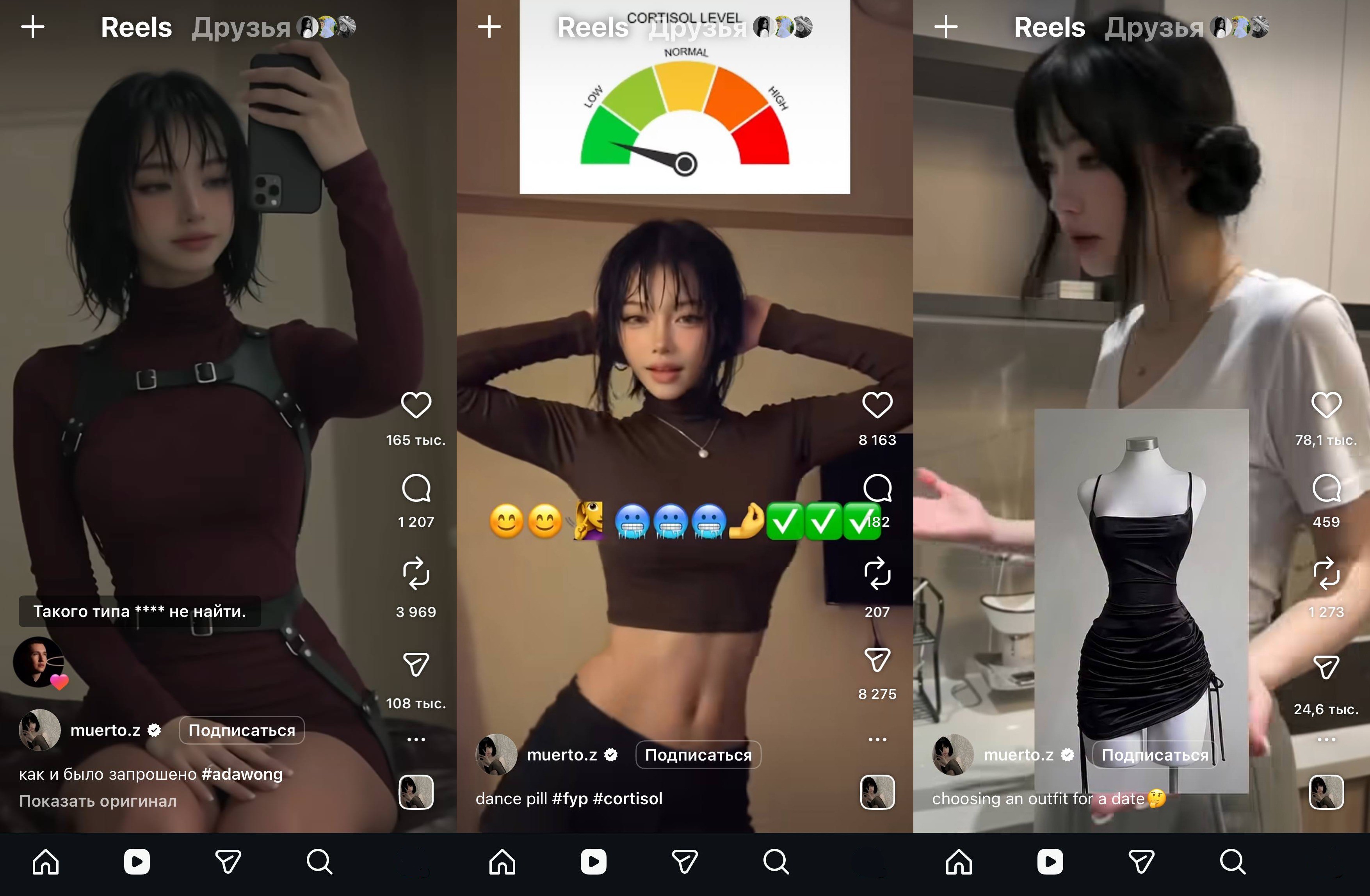
The cosplay ended up being one of the most successful clips among the account’s recent posts. Earlier material was much simpler and leaned more heavily on the model’s looks. Over time, the creators started weaving in more pop-culture elements, memes and storylines the audience already knows.
You can see the same evolution with other major AI influencers.
Takeaway
Competition among virtual bloggers keeps growing. A few months ago, an unusual, attractive girl might have been enough to grab attention. Today the novelty effect is fading, and viewers expect more thought-out content.
The market is increasingly following the rules of classic content marketing. The biggest edge goes to whoever finds an interesting idea fastest, understands the audience precisely, and is first to execute an unusual format. Even market leaders, including Muerto, have to keep evolving their content and adding new triggers to hold on to their followers’ attention.
Many popular AI girls started out as simply pretty virtual models. Only after their accounts grew did the creators have to adapt them to memes, subcultures and audience interests.
You can take a more systematic approach: pick a direction upfront, plan out the looks, personality and traits of your character, then build content around a specific niche. That approach makes for a more coherent image, an easier search for references, and a much wider range of possible scenarios.
Subscribe to our Telegram channel.
Create the look and content for your AI influencer
Photo, video and voice in one account — Nano Banana, Kling, Veo 3. No VPN needed.
Start for free